SaaS revenue operations guide
Best Email Tools for SaaS Pricing and Plan Changes in 2026
Choose a platform that can make plan changes precise, segmented, and safe to operate.
A SaaS pricing email is rarely just a broadcast. A plan change may need an effective date, grandfathering rules, invoice impact, tax or region details, a contact path, and a record of who received which version. An upgrade journey has a different job: it should react to product usage, explain value, and stop when an account changes plan.
Use this shortlist to separate CRM-led messaging, behavioral lifecycle automation, transactional delivery, and lightweight campaign tools. Pricing pages change frequently, and a vendor’s marketing price is not a complete cost model: include profiles, contacts, sends, seats, channels, data movement, engineering time, and governance. Confirm current terms with the official sources before procurement.
TL;DR — Top 5 Picks
1. Sequenzy: Upgrade education — subscription-aware follow-up after billing truth, from $19/mo for 15,000 emails.
2. Postmark: Contractual notices — deterministic billing mail on isolated streams.
3. Customer.io: Event-driven upgrades — billing-field governance with exits.
4. Userlist: Account-aware messaging — plan context per company and role.
5. HubSpot: CRM ownership — plan changes tied to owners and stages.
How Pricing Tools Are Scored
Every tool above is judged on five billing-communication criteria. A platform can be excellent software and still rank lower here if it treats a contract notice as a campaign.
- Determinism: are triggers, versions and recipients reproducible and auditable?
- Truth boundaries: do calculations stay in billing while email educates?
- Version control: are plan, region and consent variants tracked explicitly?
- Grandfathering support: can cohorts keep terms through defined periods?
- Cost honesty: can total operating cost be modeled before signing?
| Tool | Best for | Distinctive strength | Main caveat |
|---|---|---|---|
| Sequenzy | Lean plan-change education and upgrade sequences | Readable campaigns, sequences, segmentation, and ownership loops | Validate billing events, approval, SSO, and reporting requirements |
| Customer.io | Event-driven upgrade and expansion journeys | Rich event, attribute, and data-pipeline orchestration | Needs disciplined billing-field governance and lifecycle exits |
| Userlist | Account-aware SaaS plan messaging | Company-level traits and product-led segmentation | Confirm transactional and finance-system requirements |
| Postmark | Reliable contractual billing notices | Transactional delivery, templates, and message streams | Not a visual lifecycle or promotional campaign platform |
| Brevo | Mixed announcement and lifecycle programs | Campaigns, automations, SMS, and transactional sending | Separate legal or billing notices from marketing consent |
| HubSpot | Pricing changes tied to CRM ownership | CRM context, account owners, sales tasks, and email | Broad packaging can make a small pricing workflow expensive |
| ActiveCampaign | Upgrade education and renewal nurture | Conditional automations, tags, and sales handoffs | Promotion and contractual messaging need separate controls |
| Klaviyo | Usage-led expansion for SaaS with rich events | Profile data, predictive signals, and experimentation | Its ecommerce heritage may require extra implementation work |
| Mailchimp | Straightforward pricing announcements | Familiar editor, broadcasts, and basic journeys | Account-level billing logic can outgrow standard segments |
| MailerLite | Lean upgrade campaigns for smaller SaaS teams | Accessible campaigns, forms, and simple automations | Validate event depth and finance-system synchronization |
| Kit | Creator-led SaaS or audience-first launches | Tags, sequences, and simple creator workflows | Less natural for complex company, invoice, or seat logic |
| Resend | Developer-owned plan and invoice notifications | API-first sending with templates and developer ergonomics | Teams build segmentation, approvals, and reporting around it |
| SendGrid | High-volume operational and announcement delivery | Templates, APIs, delivery events, and mature sending controls | Requires clear ownership of audience logic and suppressions |
| Mailgun | Programmable billing mail with delivery observability | API, logs, webhooks, and engineering-friendly diagnostics | The team owns content workflow and commercial segmentation |
| Amazon SES | Cost-sensitive sending infrastructure at scale | Low-level control and economical programmable delivery | Templates, preferences, approvals, and reporting are build work |
Sequenzy: pricing communication fit
Best for: Lean plan-change education and upgrade sequences. Readable campaigns, sequences, segmentation, and ownership loops That makes it a sensible candidate when the team can define the source of truth for plan, seats, renewal date, and account owner. For a contractual notice, keep the trigger deterministic and preserve the rendered message or event payload for support and finance follow-up.
Why it may fit: Readable campaigns, sequences, segmentation, and ownership loops Trade-off: Validate billing events, approval, SSO, and reporting requirements. Pricing caveat: Priced by monthly email volume with unlimited contacts: $19/month for 15,000 emails, $29 for 30,000 and $49 for 60,000, plus a free tier of 2,500 emails (read 7 Oct 2026). Review the official pricing or product source and compare the full operating model, not only the entry plan. Related internal context: Sequenzy and SaaS email guidance.
Customer.io: pricing communication fit
Best for: Event-driven upgrade and expansion journeys. Rich event, attribute, and data-pipeline orchestration That makes it a sensible candidate when the team can define the source of truth for plan, seats, renewal date, and account owner. For a contractual notice, keep the trigger deterministic and preserve the rendered message or event payload for support and finance follow-up.
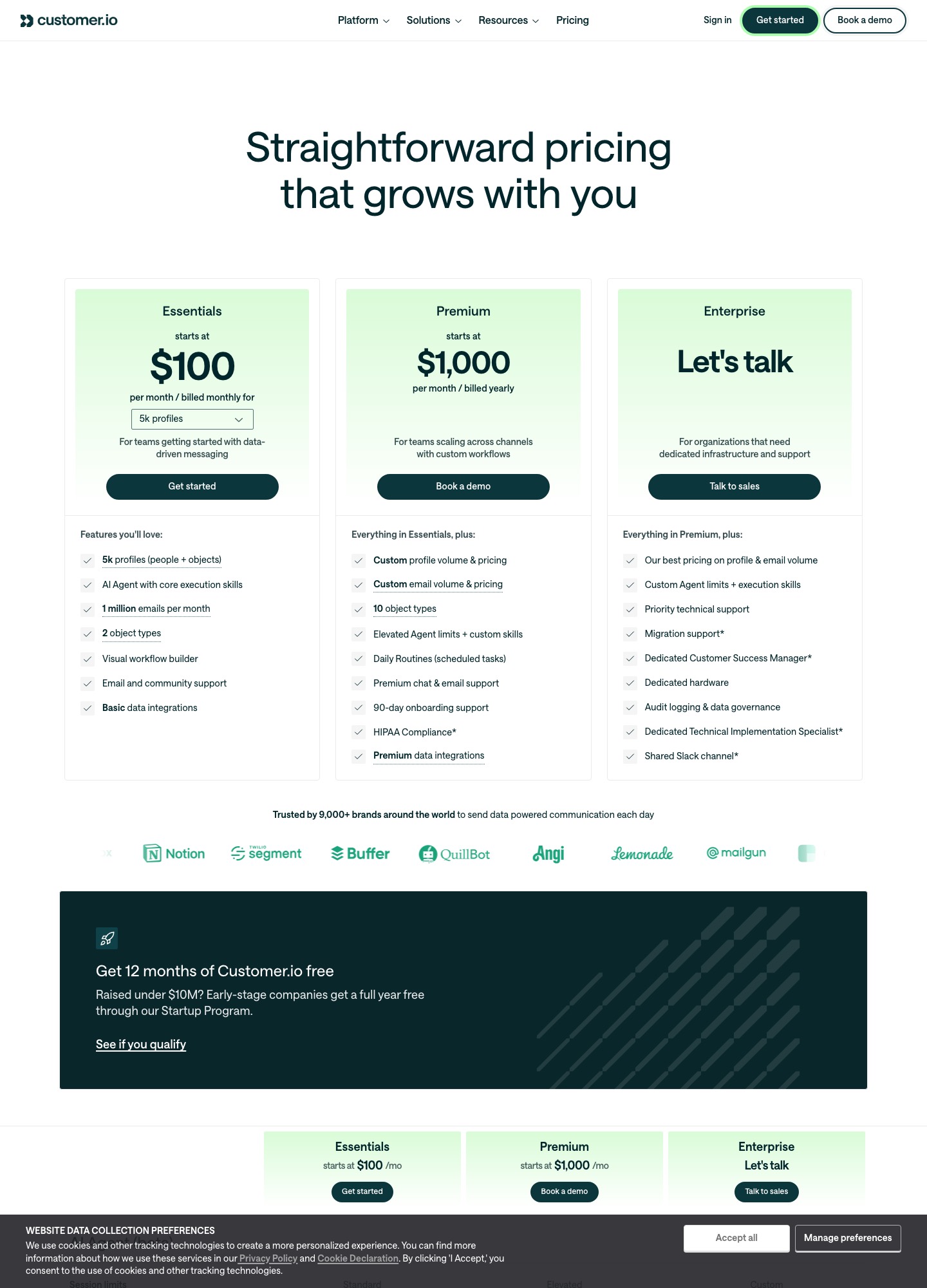
Why it may fit: Rich event, attribute, and data-pipeline orchestration Trade-off: Needs disciplined billing-field governance and lifecycle exits. Pricing caveat: Essentials starts at $100/month billed monthly for 5,000 profiles and Premium starts at $1,000/month billed yearly (read 7 Oct 2026). Review the official pricing or product source and compare the full operating model, not only the entry plan. Related internal context: Customer.io and SaaS email guidance.
Userlist: pricing communication fit
Best for: Account-aware SaaS plan messaging. Company-level traits and product-led segmentation That makes it a sensible candidate when the team can define the source of truth for plan, seats, renewal date, and account owner. For a contractual notice, keep the trigger deterministic and preserve the rendered message or event payload for support and finance follow-up.
Why it may fit: Company-level traits and product-led segmentation Trade-off: Confirm transactional and finance-system requirements. Pricing caveat: Basic is $149/month for up to 10,000 users and Professional is $349/month, with each extra 1,000 users adding $10 or $12 a month (read 7 Oct 2026). Review the official pricing or product source and compare the full operating model, not only the entry plan. Related internal context: Userlist and SaaS email guidance.
Postmark: pricing communication fit
Best for: Reliable contractual billing notices. Transactional delivery, templates, and message streams That makes it a sensible candidate when the team can define the source of truth for plan, seats, renewal date, and account owner. For a contractual notice, keep the trigger deterministic and preserve the rendered message or event payload for support and finance follow-up.
Why it may fit: Transactional delivery, templates, and message streams Trade-off: Not a visual lifecycle or promotional campaign platform. Pricing caveat: The free plan covers 100 emails a month; Basic starts at $15/month for 10,000 emails, Pro at $16.50 and Platform at $18 (read 7 Oct 2026). Review the official pricing or product source and compare the full operating model, not only the entry plan. Related internal context: Postmark and SaaS email guidance.
Brevo: pricing communication fit
Best for: Mixed announcement and lifecycle programs. Campaigns, automations, SMS, and transactional sending That makes it a sensible candidate when the team can define the source of truth for plan, seats, renewal date, and account owner. For a contractual notice, keep the trigger deterministic and preserve the rendered message or event payload for support and finance follow-up.
Why it may fit: Campaigns, automations, SMS, and transactional sending Trade-off: Separate legal or billing notices from marketing consent. Pricing caveat: Plan, email volume, and add-ons change the total. Review the official pricing or product source and compare the full operating model, not only the entry plan. Related internal context: Brevo and SaaS email guidance.
HubSpot: pricing communication fit
Best for: Pricing changes tied to CRM ownership. CRM context, account owners, sales tasks, and email That makes it a sensible candidate when the team can define the source of truth for plan, seats, renewal date, and account owner. For a contractual notice, keep the trigger deterministic and preserve the rendered message or event payload for support and finance follow-up.
Why it may fit: CRM context, account owners, sales tasks, and email Trade-off: Broad packaging can make a small pricing workflow expensive. Pricing caveat: Hub, contacts, seats, and marketing limits can stack. Review the official pricing or product source and compare the full operating model, not only the entry plan. Related internal context: HubSpot and SaaS email guidance.
ActiveCampaign: pricing communication fit
Best for: Upgrade education and renewal nurture. Conditional automations, tags, and sales handoffs That makes it a sensible candidate when the team can define the source of truth for plan, seats, renewal date, and account owner. For a contractual notice, keep the trigger deterministic and preserve the rendered message or event payload for support and finance follow-up.
Why it may fit: Conditional automations, tags, and sales handoffs Trade-off: Promotion and contractual messaging need separate controls. Pricing caveat: Contact count and feature tier drive cost; verify current terms. Review the official pricing or product source and compare the full operating model, not only the entry plan. Related internal context: ActiveCampaign and SaaS email guidance.
Klaviyo: pricing communication fit
Best for: Usage-led expansion for SaaS with rich events. Profile data, predictive signals, and experimentation That makes it a sensible candidate when the team can define the source of truth for plan, seats, renewal date, and account owner. For a contractual notice, keep the trigger deterministic and preserve the rendered message or event payload for support and finance follow-up.
Why it may fit: Profile data, predictive signals, and experimentation Trade-off: Its ecommerce heritage may require extra implementation work. Pricing caveat: Profiles, email, and optional channels affect pricing. Review the official pricing or product source and compare the full operating model, not only the entry plan. Related internal context: Klaviyo and SaaS email guidance.
Mailchimp: pricing communication fit
Best for: Straightforward pricing announcements. Familiar editor, broadcasts, and basic journeys That makes it a sensible candidate when the team can define the source of truth for plan, seats, renewal date, and account owner. For a contractual notice, keep the trigger deterministic and preserve the rendered message or event payload for support and finance follow-up.
Why it may fit: Familiar editor, broadcasts, and basic journeys Trade-off: Account-level billing logic can outgrow standard segments. Pricing caveat: Contacts, sends, seats, and add-ons vary by plan. Review the official pricing or product source and compare the full operating model, not only the entry plan. Related internal context: Mailchimp and SaaS email guidance.
MailerLite: pricing communication fit
Best for: Lean upgrade campaigns for smaller SaaS teams. Accessible campaigns, forms, and simple automations That makes it a sensible candidate when the team can define the source of truth for plan, seats, renewal date, and account owner. For a contractual notice, keep the trigger deterministic and preserve the rendered message or event payload for support and finance follow-up.
Why it may fit: Accessible campaigns, forms, and simple automations Trade-off: Validate event depth and finance-system synchronization. Pricing caveat: Subscribers and feature tier determine current plan cost. Review the official pricing or product source and compare the full operating model, not only the entry plan. Related internal context: MailerLite and SaaS email guidance.
Kit: pricing communication fit
Best for: Creator-led SaaS or audience-first launches. Tags, sequences, and simple creator workflows That makes it a sensible candidate when the team can define the source of truth for plan, seats, renewal date, and account owner. For a contractual notice, keep the trigger deterministic and preserve the rendered message or event payload for support and finance follow-up.
Why it may fit: Tags, sequences, and simple creator workflows Trade-off: Less natural for complex company, invoice, or seat logic. Pricing caveat: Subscriber and feature limits change by plan. Review the official pricing or product source and compare the full operating model, not only the entry plan. Related internal context: Kit and SaaS email guidance.
Resend: pricing communication fit
Best for: Developer-owned plan and invoice notifications. API-first sending with templates and developer ergonomics That makes it a sensible candidate when the team can define the source of truth for plan, seats, renewal date, and account owner. For a contractual notice, keep the trigger deterministic and preserve the rendered message or event payload for support and finance follow-up.
Why it may fit: API-first sending with templates and developer ergonomics Trade-off: Teams build segmentation, approvals, and reporting around it. Pricing caveat: The free plan allows 3,000 emails a month (100 a day); Pro is $20/month for 50,000 emails and Scale is $90/month for 100,000 (read 7 Oct 2026). Review the official pricing or product source and compare the full operating model, not only the entry plan. Related internal context: Resend and SaaS email guidance.
SendGrid: pricing communication fit
Best for: High-volume operational and announcement delivery. Templates, APIs, delivery events, and mature sending controls That makes it a sensible candidate when the team can define the source of truth for plan, seats, renewal date, and account owner. For a contractual notice, keep the trigger deterministic and preserve the rendered message or event payload for support and finance follow-up.
Why it may fit: Templates, APIs, delivery events, and mature sending controls Trade-off: Requires clear ownership of audience logic and suppressions. Pricing caveat: API, marketing, seats, and volume tiers are separate considerations. Review the official pricing or product source and compare the full operating model, not only the entry plan. Related internal context: SendGrid and SaaS email guidance.
Mailgun: pricing communication fit
Best for: Programmable billing mail with delivery observability. API, logs, webhooks, and engineering-friendly diagnostics That makes it a sensible candidate when the team can define the source of truth for plan, seats, renewal date, and account owner. For a contractual notice, keep the trigger deterministic and preserve the rendered message or event payload for support and finance follow-up.
Why it may fit: API, logs, webhooks, and engineering-friendly diagnostics Trade-off: The team owns content workflow and commercial segmentation. Pricing caveat: Volume, validation, and deliverability features may add cost. Review the official pricing or product source and compare the full operating model, not only the entry plan. Related internal context: Mailgun and SaaS email guidance.
Amazon SES: pricing communication fit
Best for: Cost-sensitive sending infrastructure at scale. Low-level control and economical programmable delivery That makes it a sensible candidate when the team can define the source of truth for plan, seats, renewal date, and account owner. For a contractual notice, keep the trigger deterministic and preserve the rendered message or event payload for support and finance follow-up.
Why it may fit: Low-level control and economical programmable delivery Trade-off: Templates, preferences, approvals, and reporting are build work. Pricing caveat: Regional usage pricing and adjacent AWS services matter. Review the official pricing or product source and compare the full operating model, not only the entry plan. Related internal context: Amazon SES and SaaS email guidance.
What four vendors charge for a plan-change notice (7 Oct 2026)
The tools above meter different things, so the same notice costs different amounts depending on whether you are billed by emails sent, by profiles or by users. These are the figures the vendors' own pricing pages showed on 7 October 2026.
| Vendor | Entry price on its pricing page | What the price is based on |
|---|---|---|
| Postmark | Basic from $15/month, Pro $16.50, Platform $18 | 10,000 emails a month included, extra emails $1.80 per 1,000 on Basic |
| Resend | Pro $20/month, Scale $90/month | 50,000 and 100,000 emails a month; extra emails $0.90 per 1,000 |
| Customer.io | Essentials from $100/month billed monthly | 5,000 profiles shown by default, with 1 million emails a month included |
| Userlist | Basic $149/month, Professional $349/month | Up to 10,000 users; each extra 1,000 users adds $10 (Basic) or $12 (Professional) a month |
Take a concrete case: a price change that must reach 10,000 customer accounts, followed by one reminder, so 20,000 sends in a month. On Postmark Basic the first 10,000 are included and the other 10,000 are ten extra blocks of 1,000 at $1.80 each on top of the $15 base. Resend's Pro plan covers 50,000 emails a month for $20, so the same volume sits well inside it. Those two are sending infrastructure, though: the segmentation, the effective-date logic and the exit rules are still yours to build.
Customer.io and Userlist price the audience rather than the sends. Customer.io's Essentials plan starts at $100 a month for 5,000 profiles, and the screenshot below shows the page as captured; the profile count is the lever, so a list of 10,000 accounts needs a larger profile tier than the default view shows. Userlist's Basic plan lists $149 a month at 10,000 users, which means a 10,000-account notice with company-level segmentation lands there. If your notices are rare and your audience is large, a send-metered tool is usually cheaper; if you run upgrade journeys all month against a small, active base, the audience-priced tools are easier to forecast.
Match the tool to the message
| Message type | Shortlist | Non-negotiable control |
|---|---|---|
| Contractual price or billing notice | Postmark, Resend, SendGrid, Mailgun | Deterministic trigger, audit trail, suppression rules |
| Behavioral upgrade journey | Customer.io, Userlist, ActiveCampaign, Klaviyo | Fresh product events and an upgrade exit condition |
| Broad announcement | Brevo, Mailchimp, MailerLite | Version by plan, region, and consent status |
| CRM-owned account communication | HubSpot | Owner handoff and billing data permissions |
| Infrastructure-first sending | Amazon SES | Team-owned templates, preferences, and observability |
Run a pricing-email pilot
Start with one low-risk upgrade journey and one controlled plan-change notice. Do not use a live contractual send as the first test. Use a test cohort that includes current plans, grandfathered accounts, multiple regions, cancelled accounts, and a missing-data case.
| Pilot check | Pass condition | Evidence to retain |
|---|---|---|
| Audience accuracy | Every recipient maps to a current plan and region | Exported audience and query version |
| Message rendering | Effective date, amount, CTA, and support path are correct | Rendered previews across major clients |
| Lifecycle safety | Upgrade, cancellation, and bounce events stop or reroute mail | Event log and suppression test |
| Cost model | Projected profiles, sends, seats, and integration work are documented | Three-month estimate using current vendor terms |
Procurement questions worth answering
| Question | Why it changes the decision |
|---|---|
| Can finance approve a message before it sends? | Separates campaign convenience from contractual control. |
| Can the system identify companies as well as contacts? | Prevents seat or plan changes from being communicated at the wrong person level. |
| What happens when billing data is late or missing? | Shows whether the platform fails safely or sends an inaccurate offer. |
| Can we export events, versions, and delivery evidence? | Supports support tickets, audits, and post-send analysis. |
Continue with the automation use cases, billing tools guide, and alternatives hub.
Verdict
Every pricing email must answer four questions or it creates a support ticket: who is affected, what changes, when it happens, and where the customer can act. Prospects, active users, administrators, and billing contacts each need different information, and the announcement that blasts one version to all four is how pricing changes become churn events. Publish only claims that match the current source of truth. Sequenzy (from $19/month for 15,000 emails) runs the plan-change education layer — readable campaigns and ownership loops around upgrades and renewals — with billing events, approval, SSO, and reporting validated before anything sends.
Run the pricing-email pilot before any contractual send: one low-risk upgrade journey, one controlled plan-change notice, a test cohort spanning current plans, grandfathered accounts, regions, cancellations, and a missing-data case. The pricing email contradicted by the invoice destroys trust faster than any price increase.
Frequently asked questions
What is the real cost of a SaaS pricing-email tool?
Include profiles or contacts, sends, seats, premium automation, integrations, implementation, QA, support, data retention, and the cost of handling a correction. Model current usage and at least two-times growth before comparing plans.
Should pricing notices be sent from the same workflow as marketing?
Keep deterministic plan or billing notices distinct from promotional upgrade journeys. Finance and support should be able to review the trigger, effective date, recipient, rendered version, and suppression outcome.
Where does Sequenzy fit for SaaS pricing communication?
Sequenzy is worth piloting for subscription-aware upgrade education or lifecycle follow-up after the authoritative billing state is available. Keep contractual calculations in the billing system and test missing data, cancellation, upgrade, and support-escalation exits.
How do you announce a price increase without churning accounts?
With advance notice, grandfathering clarity, and value evidence: announce 60 to 90 days ahead, state exactly what changes for each plan with effective dates, honor existing terms through their committed periods, and lead with the value delivered since the last change. Never bury increases in unrelated updates or shorten notice to dodge objections — discovered surprises churn more accounts than honest increases. Provide a human contact for questions and track objection themes to address them proactively.
What is grandfathering and when should you offer it?
Grandfathering lets existing customers keep current pricing or terms through a defined period after a change. Offer it when the change is substantial, the base is loyal, or contracts imply continuity — typically honoring terms through the current contract plus one renewal cycle. Document who qualifies, for how long, and what triggers the new terms, because ambiguous grandfathering creates support debt and perceived unfairness. Time-bound grandfathering balances fairness with economics; permanent grandfathering subsidizes the past at the future’s expense.