SaaS lifecycle comparison · Prices checked October 7, 2026
ActiveCampaign vs HubSpot for SaaS
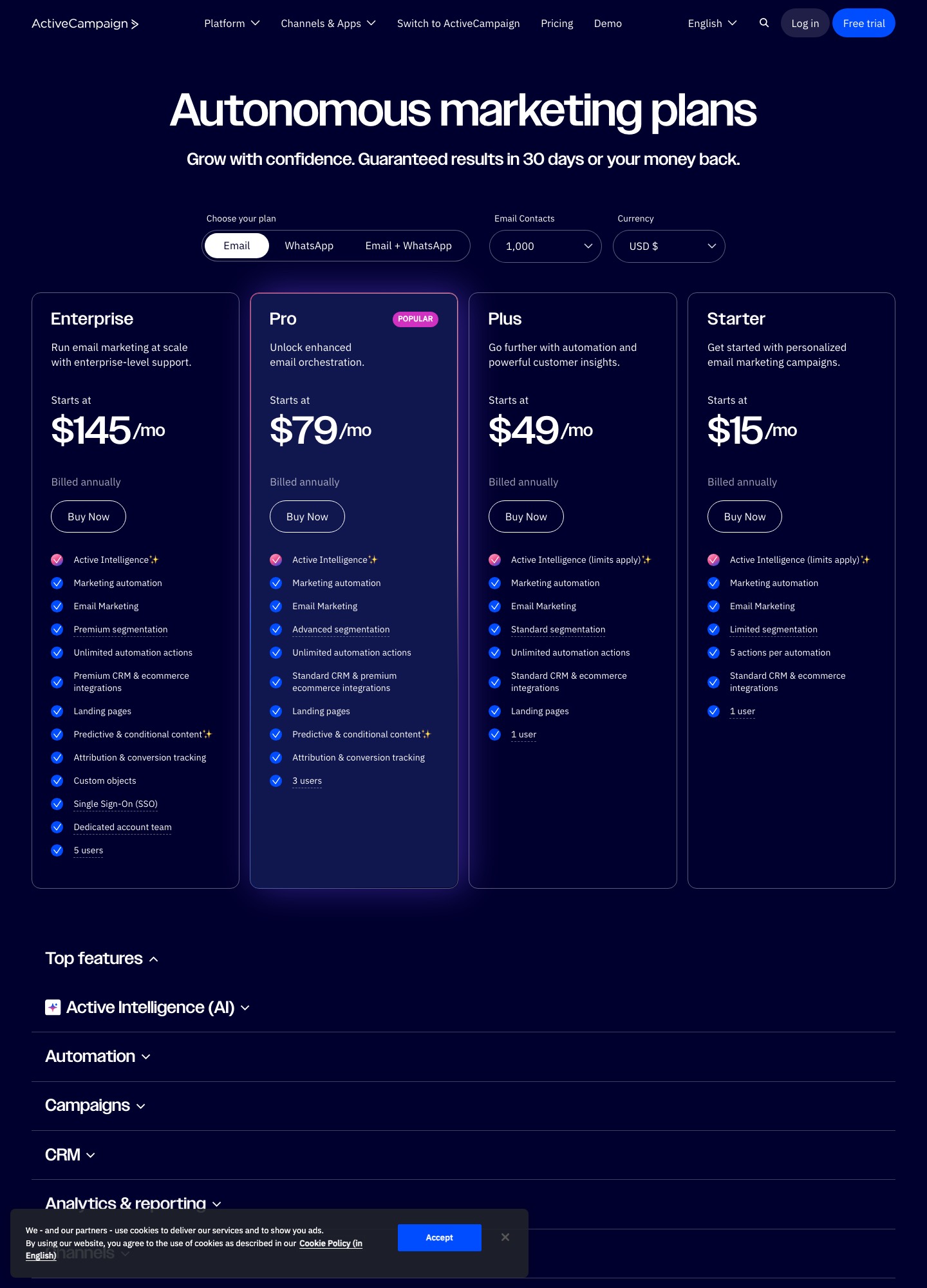
Choose ActiveCampaign when lifecycle email is the center of the stack and HubSpot when marketing, sales, service, and CRM must share one system. ActiveCampaign starts at $15/month for 1,000 contacts on its Starter plan. HubSpot has free tools and a $7/month Starter tier, but its Professional and Enterprise tiers are $800/month and $3,600/month. The lower entry price does not describe the same scope.
Both products can send onboarding, trial, and lead-nurture messages. Their buying units differ. ActiveCampaign presents a contact-based email plan with automation and a small CRM. HubSpot prices Marketing Hub by plan, marketing-contact tier, and feature scope, with credits and usage costs called out on its pricing page. For a SaaS team, the first decision is ownership: does marketing own the lifecycle engine, or should the same record and workflow span demand generation, sales, and service?
At a glance
| Decision point | ActiveCampaign | HubSpot Marketing Hub |
|---|---|---|
| Entry price | Starter $15/mo, billed annually, at 1,000 contacts | Free tools; Starter $7/mo |
| Higher tiers | Plus $49, Pro $79, Enterprise $145/mo | Professional $800, Enterprise $3,600/mo |
| Focus | Email marketing, automation, standard CRM | Marketing platform inside a broader CRM suite |
| Free option | No ongoing free plan; free trial available | Free tools with 2,000 marketing email sends/month and branding |
| Send rule | Plan price scales with selected email contacts | Starter includes 5× the marketing-contact-tier send limit |
Prices are list prices from the checked vendor pages, not a quote for your exact contact count. HubSpot’s $7 Starter line and $800 Professional line are different packages, so compare included automation and contact tier.
Where ActiveCampaign fits
ActiveCampaign is the cleaner fit when one marketing or lifecycle team owns the brief: capture a signup, wait for a product event, branch on plan or behavior, and stop when the account reaches the next state. The checked Starter tier includes email marketing, marketing automation, standard CRM, and ecommerce integrations. Plus adds standard segmentation and landing pages; Pro adds advanced segmentation; Enterprise adds premium segmentation and a dedicated account team.
The advantage is a narrower operating surface. A team can define a trial sequence, activation branch, billing-failure handoff, and re-engagement exit without buying a full CMS or service desk. The tradeoff is that the CRM is not the same breadth as HubSpot’s record, pipeline, and service model. ActiveCampaign also lists transactional email and SMS as add-ons, so map those costs before treating $15 as a complete messaging budget.
Where HubSpot fits
HubSpot is compelling when lifecycle email must share a durable customer record with sales, service, content, and reporting. Free tools include 2,000 marketing email sends/month with HubSpot branding and one automated action. Starter is listed at $7/month and allows up to 10 automated actions. Professional is $800/month and Enterprise is $3,600/month; both unlock broader automation and marketing controls.
That scope is useful for a SaaS with a sales-assisted motion, lead scoring, service ownership, and one reporting surface. It is expensive if the requirement is product-event email with a small number of owners. HubSpot also has marketing-contact tiers and a 5×, 10×, or 20× send relationship by plan, so model contacts and sends together.
Cost scenarios
| Scenario | ActiveCampaign | HubSpot |
|---|---|---|
| Early self-serve SaaS | Starter list price: $15/mo at 1,000 contacts | Free tools cover 2,000 sends/month; Starter is $7/mo |
| Lifecycle plus segmentation | Plus $49/mo or Pro $79/mo | Professional starts at $800/mo |
| Marketing and sales operations | Enterprise starts at $145/mo | Enterprise starts at $3,600/mo |
These are not like-for-like bundles. Use the ActiveCampaign number to test an email-led model. Use HubSpot’s figure to test whether consolidating systems removes enough handoffs to justify the jump.
Automation and data design
ActiveCampaign’s automation-first shape suits event naming owned by marketing operations: trial_started, invited_teammate, activated, and payment_failed can each enter a branch. Define suppression before importing contacts, and keep product truth in the source system. The email tool should receive the event and send the message; it should not become the billing ledger.
HubSpot is stronger when the same person needs a lifecycle state, sales owner, service history, and campaign membership. That makes a handoff visible, but field governance becomes part of email work. Decide which properties are marketing contacts, who can change lifecycle stage, and how an account event maps to contact records before building automation.
Choose ActiveCampaign if…
- Email automation is the primary system you are buying.
- You want a clear annual list price starting at $15.
- One team can own CRM, segmentation, and lifecycle rules.
- You can budget separately for transactional email or SMS add-ons.
Choose HubSpot if…
- Sales and service need the same record and workflow context.
- You will use lead scoring, content, ads, and reporting alongside email.
- Free tools or Starter’s $7 tier are useful for an early stage with a path to Professional.
- A larger platform bill is acceptable in exchange for fewer handoffs.
Migration notes
Moving from ActiveCampaign to HubSpot means mapping contacts, custom fields, tags, goals, automations, forms, and consent history. Rebuild each automation from its entry event and exit condition; a tag export does not preserve timing, branches, or suppression. Test one trial cohort first and compare sends, unsubscribes, and downstream product events.
Moving from HubSpot to ActiveCampaign is a scope reduction exercise. Export contact properties, lifecycle stages, lists, subscription status, and scoring definitions. Keep the CRM or service system as source of truth if those teams remain on it, then send only fields ActiveCampaign needs for segmentation and automation.
FAQ
Is ActiveCampaign cheaper than HubSpot?
The checked entry prices are $15/month for ActiveCampaign Starter and $7/month for HubSpot Starter, while HubSpot Professional is $800/month and Enterprise is $3,600/month. The plans package different capabilities.
Does HubSpot have a free email plan?
HubSpot’s record lists free tools with 2,000 marketing email sends/month and branding. It also lists one automated action, so complex onboarding needs a paid tier or another workflow owner.
Which is better for product-led SaaS onboarding?
ActiveCampaign is simpler when the job is event-led email and a small CRM. HubSpot is better when onboarding must share ownership with sales, service, content, and broader records.
Can I migrate automations directly?
Plan on rebuilding them. Export the data and document each trigger, wait, branch, goal, and suppression rule, then test a representative cohort.
Continue with Customer.io vs Drip, review Encharge vs Customer.io, or browse the SaaS comparisons hub. See our evaluation method.