SaaS lifecycle comparison · Prices checked October 7, 2026
Loops vs Mailchimp: Pricing and Fit for SaaS Teams
Choose Loops if you are a software product that sends event-driven onboarding and product email and wants one bill for marketing and transactional sends. Choose Mailchimp if you also run newsletters, ecommerce campaigns or SMS and want its larger template and integration set. On list prices Loops is lower at each size we checked: about $99/month near 10,000 subscribers versus $135/month for Mailchimp Standard at 5,001–10,000 contacts.
These two are less alike than their shared category suggests. Loops is a SaaS-focused sender: its docs are organised around workflows, events, contacts, transactional email and an API, and its pricing page says paid plans scale only with subscribed contacts. Mailchimp is a general marketing suite where the Standard plan is priced by audience band and capped by a send allowance. If your emails are triggered by something a user did inside your app, that difference is the real decision. If your emails are mostly scheduled campaigns to a list, Mailchimp's breadth starts to matter.
Side by side
| Decision point | Loops | Mailchimp |
|---|---|---|
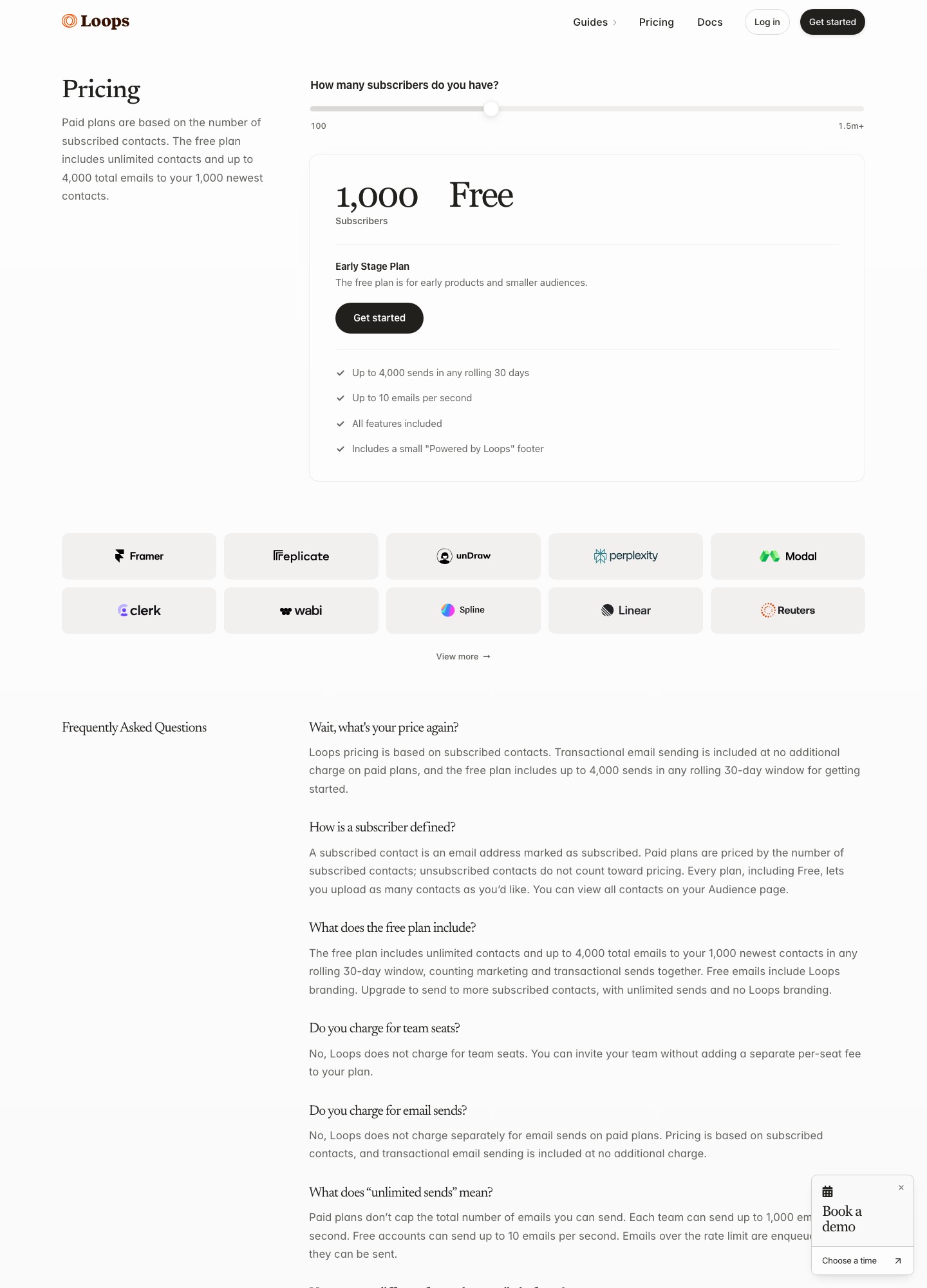
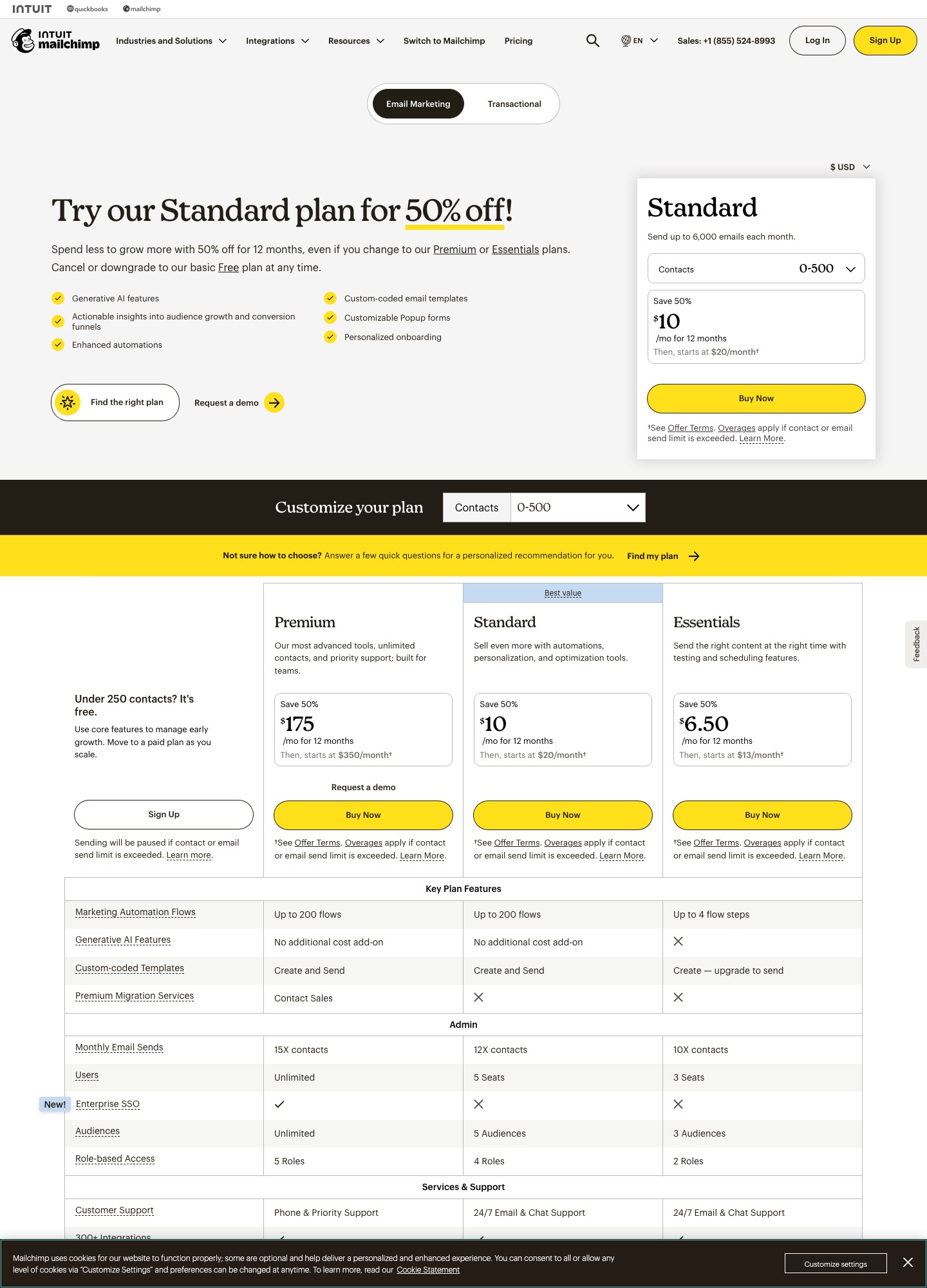
| Free plan | Unlimited contacts, up to 4,000 sends in any rolling 30 days to your 1,000 newest contacts, "Powered by Loops" footer | Up to 250 contacts and 500 sends a month (250 a day), one audience |
| Paid pricing unit | Subscribed contacts only; unsubscribed contacts do not count | Contact band, plus a monthly send limit of 12× the contact count on Standard |
| Entry paid price | About $48/mo near 4,800 subscribers | Standard from $20/mo at the 500-contact default, then $100/mo at 2,501–5,000 |
| Sending limits | Unlimited sends on paid plans; 1,000 emails per second per team | Overages apply if the contact or send limit is exceeded |
| Transactional email | Included on paid plans at no additional charge | Sold as a separate Transactional product with its own pricing page |
| Team seats | No per-seat fee | Free plan includes one seat |
| Automation and segmentation | Workflows, events and goals documented; all features on every plan | Segmentation, enhanced automations, A/B and multivariate tests (up to eight variations) |
| Integrations | REST API, webhooks, SMTP, Zapier, Make, MCP server and CLI in the docs | Shopify, WooCommerce, Canva, Zapier, Square, Wix, Salesforce, WordPress and more |
| Extras | MJML supported for transactional templates | Generative AI features, popup forms, custom-coded templates, SMS marketing |
The "all features included" line on Loops matters when you compare. Its free plan and its paid plans differ in limits and branding, not in capabilities, whereas Mailchimp separates Free, Essentials, Standard and Premium by feature set as well as by contact count.
Cost at three list sizes
Both vendors price from a selector on the pricing page. These are the list prices each page displayed on the check date. The Loops slider moves in uneven steps, so each row notes the nearest subscriber count it showed. Mailchimp's rows are the Standard plan's regular price; the page was also advertising 50% off the first 12 months, which is a promotion that ends.
| Audience | Loops | Mailchimp Standard | Difference |
|---|---|---|---|
| About 5,000 | $48/mo at 4,788 subscribers | $100/mo (2,501–5,000 contacts) | Mailchimp is $52 higher |
| About 10,000 | $99/mo at 9,998 subscribers | $135/mo (5,001–10,000 contacts) | Mailchimp is $36 higher |
| About 25,000 | $198/mo at 24,339 subscribers | $310/mo (20,001–25,000 contacts) | Mailchimp is $112 higher |
Add transactional email and the gap shifts further: Loops folds password resets and receipts into the same plan, while a Mailchimp account that needs them buys the separate Transactional product on top. For a 10,000-contact product that sends welcome mail, trial reminders and a monthly product update, the Mailchimp Standard cap is 120,000 sends a month, comfortable for marketing volume but a different bill from the one that carries your in-app triggers.
The flip side is the free tier. A 300-person beta list can stay on Loops' free plan indefinitely, since the cap is 4,000 sends in a rolling 30 days to the 1,000 newest contacts. On Mailchimp's free plan, 300 contacts is already over the 250-contact limit.
Where Loops fits
Loops suits a product team that wants one place for lifecycle email. Its documentation lists workflows, events, goals, contacts and transactional email as the core learning path, and the REST API covers contacts, events, campaigns, themes and workflows. The pricing page confirms there is no seat fee and no separate send charge on paid plans, so adding a designer or a PM does not change the bill. Transactional templates can be brought in as MJML, a real plus if engineering already owns the email markup.
What the pages do not show is a depth of marketing tooling comparable to Mailchimp's: no SMS marketing, popup forms or multivariate testing appear in the Loops pricing or docs pages we read. If that stack is the point of your purchase, Loops is not the answer.
Where Mailchimp fits
Mailchimp earns its place when the audience is not only product users. Standard lists generative AI features, enhanced automations, custom-coded templates, popup forms and testing across up to eight variations. The integration catalog reaches storefront and site-builder tools like Shopify, WooCommerce, Wix and WordPress, which matters for a SaaS company that also sells merchandise or runs a content site. Its 14-day Standard trial is also a low-risk way to see whether the interface suits your marketer.
The costs are the contact-band price steps and the 12× send cap. A product that emails every contact often, for instance daily activity digests, can hit the cap before the contact band moves, and the pricing page says overages apply.
Choose Loops if…
- Your emails are triggered by events from your app and by billing or onboarding state.
- You want transactional and marketing sends under one plan and one sender reputation.
- You want to stay free while the list is small and not pay per seat.
- Your team would rather use an API, webhooks and an MCP server than a campaign calendar.
Choose Mailchimp if…
- Newsletters, promotions and storefront campaigns are as important as product email.
- You need SMS, popup forms or multivariate testing in the same tool.
- Your team already has Mailchimp audiences and templates worth keeping.
- You will pay for a separate transactional service rather than move it.
Migration notes
Moving from Mailchimp to Loops starts with the audience. Export contacts and their merge fields, then decide which fields become Loops contact properties. Loops counts only subscribed contacts toward price, so strip unsubscribed and cleaned addresses before import; on Mailchimp those rows may have inflated your band. Recreate each automation as a workflow triggered by an event sent through the API or an integration, and move transactional messages last, since Loops needs a published template per message.
The reverse move is rarer but real: a SaaS company that adds a retail arm may want Mailchimp's ecommerce integrations. Export Loops contacts with their properties, rebuild segments as Mailchimp tags or segments, and keep your transactional sender running until the new Transactional product is warmed up. Test both directions with one low-risk flow, such as a trial reminder, before moving the rest.
FAQ
Is Loops cheaper than Mailchimp?
On the list prices we checked, yes: $48, $99 and $198 a month near 5,000, 10,000 and 25,000 subscribers for Loops, against $100, $135 and $310 for Mailchimp Standard at the matching bands. Mailchimp's first-year 50% promotion can narrow that for twelve months.
Which has the better free plan?
Loops allows unlimited contacts and 4,000 sends in a rolling 30 days to your 1,000 newest contacts. Mailchimp's free plan stops at 250 contacts and 500 sends a month, so Loops is more usable for a small SaaS list.
Can Mailchimp send transactional email?
Mailchimp sells transactional email as its own product with a separate pricing page. Loops includes transactional sending in its paid plans.
Do I need developers for Loops?
Not for campaigns, which are built in an editor. Event-triggered workflows and transactional sends do need someone to send events or call the API, or to connect Zapier, Make or an integration.
Continue with Loops alternatives, Mailchimp alternatives, ConvertKit vs Mailchimp, or browse the SaaS comparisons hub. See our evaluation method.